
 Pin it
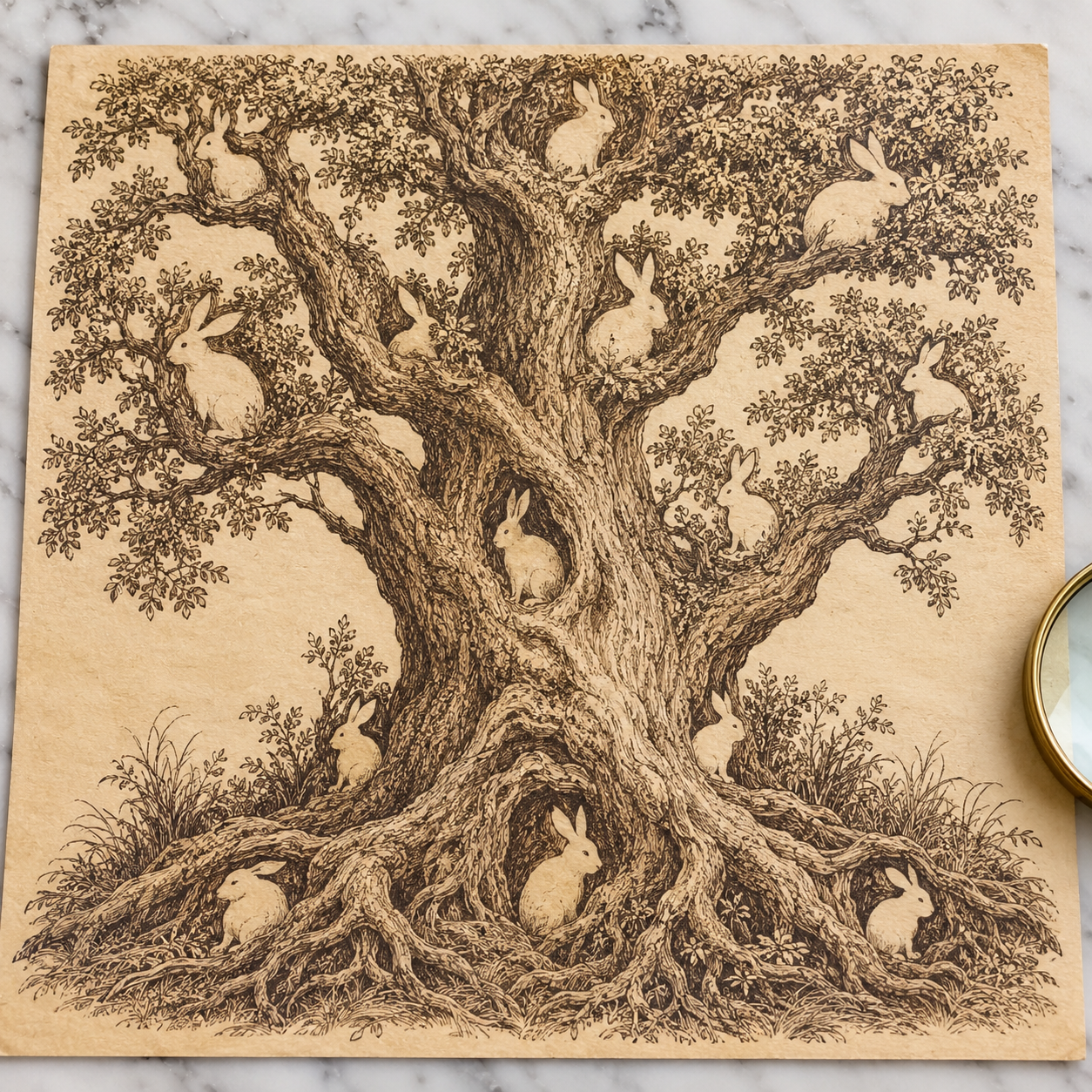
The How Many Rabbits Can You Spot beauty puzzle looks simple at first. You see an old tree, twisted roots, rough bark, and branching lines that seem to belong to the wood.
Then the shapes start shifting. A curve becomes an ear. A hollow becomes a face. A root line suddenly looks less like a root and more like a crouched rabbit.
Use this as a light observation challenge, not a personality test. The fun is in slowing down long enough to notice what your first glance skipped.
Start With The Whole Tree
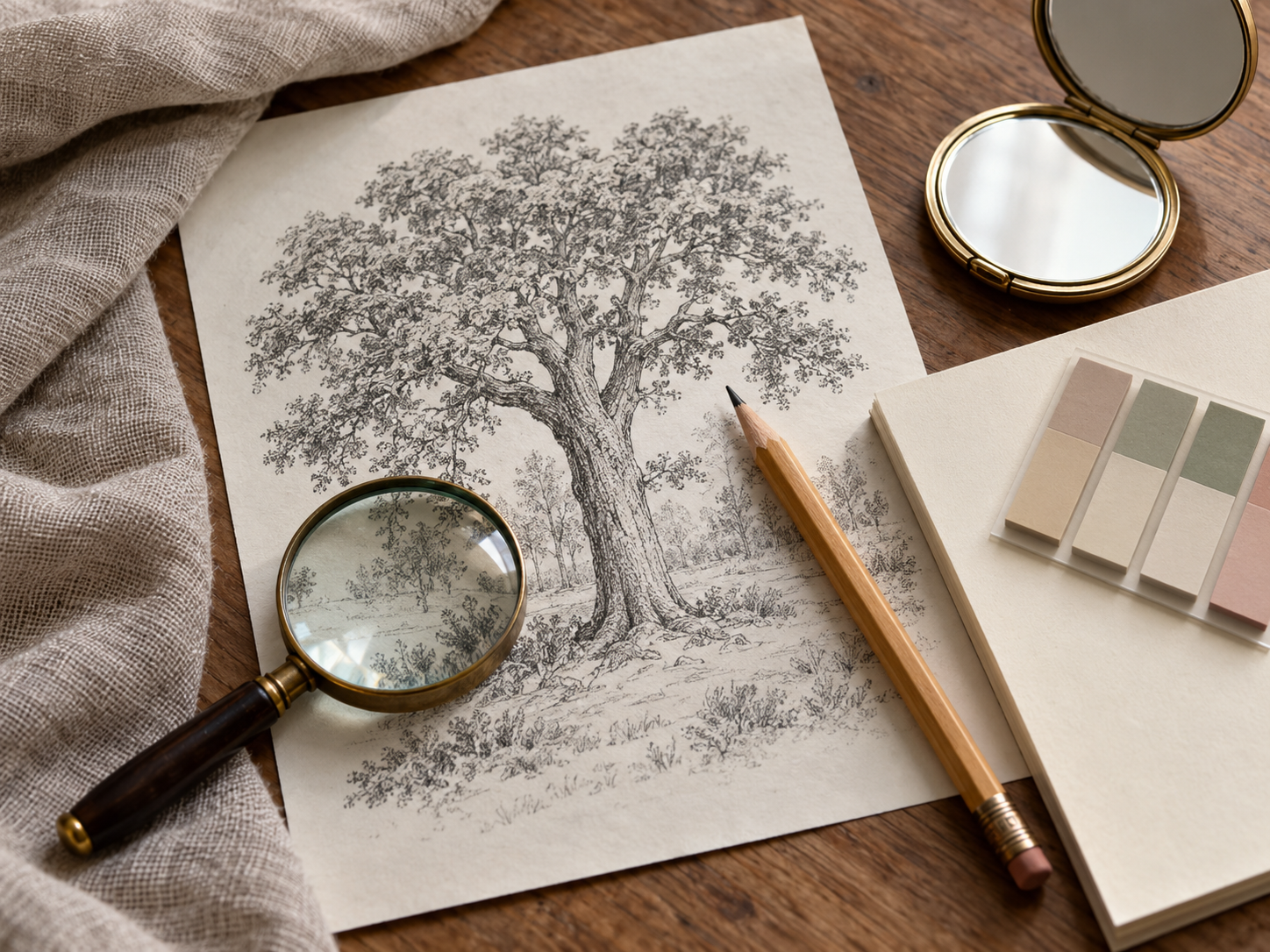
Give the image one honest full glance before you zoom in. The hidden shapes work because the tree lines do double duty. A root can be bark in one moment and a rabbit's back in the next.
If you enjoy visual challenges, this sits close to a beauty picture puzzle with 5 differences. Both reward a slower second pass more than a fast first guess.
- Root curves. These often hide crouched bodies and tucked paws.
- Branch forks. Two narrow lines can read as long rabbit ears once you stop seeing only wood.
- Tree hollows. Dark spaces can become faces, eyes, or noses.
- Bark texture. Fine lines make false edges that hide the real outline.
- Negative space. Some rabbits appear from the empty shape around the branches rather than the branch itself.
- Repeated silhouettes. Once you find one rabbit shape, similar curves become easier to notice.
Scan It Like This
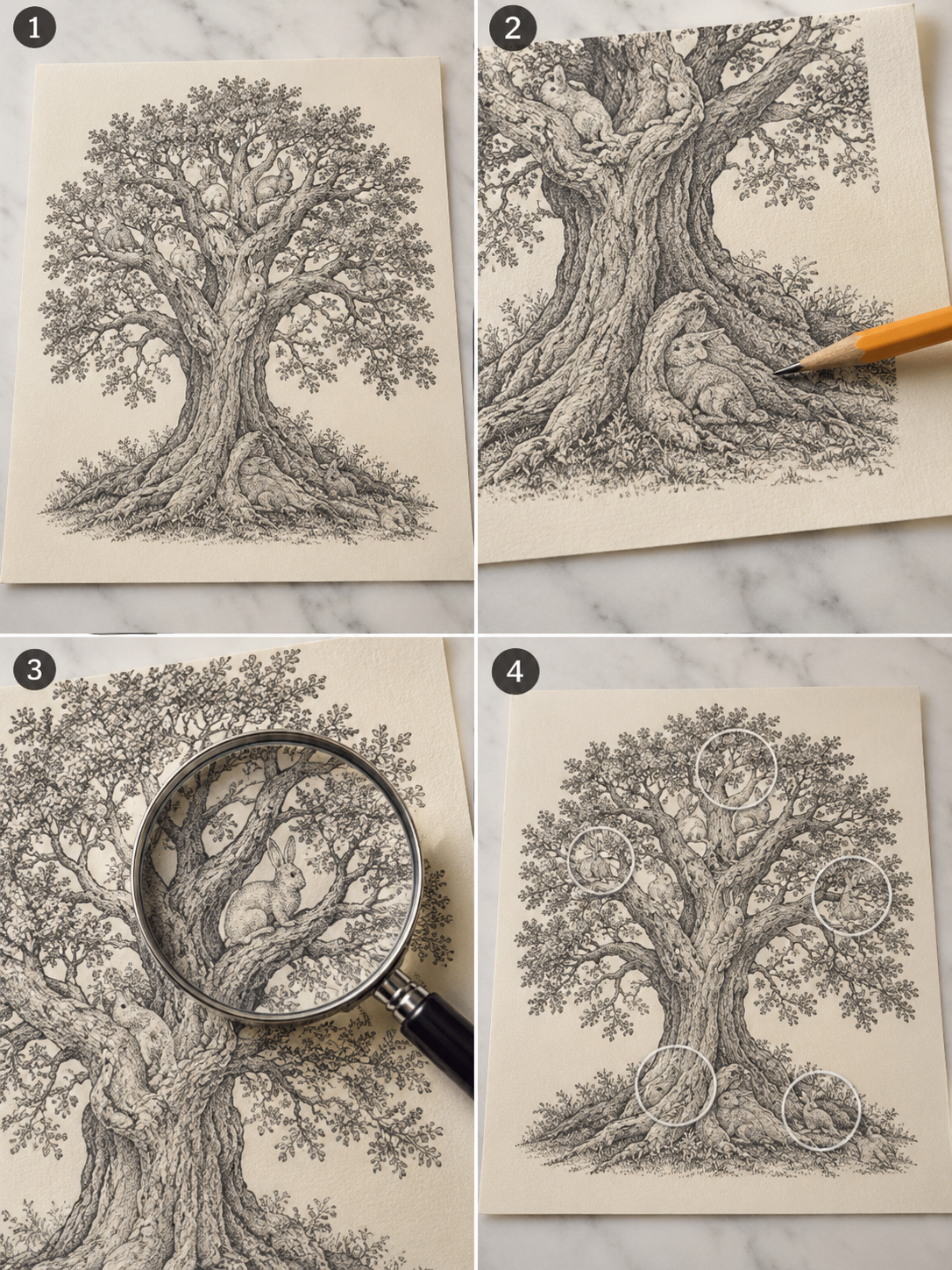
- Soften your focus. Look at the tree as a whole for a few seconds. Let the main shape settle before hunting for details.
- Work from bottom up. Start at the roots, then move through the trunk, then out to the branches. A fixed route keeps you from checking the same patch over and over.
- Search for pairs. Rabbit ears often appear as two nearby points or narrow curves. When you see ears, check below them for a face or body.
- Use the background. Do not only study the dark lines. Some of the clearest shapes come from pale spaces between roots and branches.
- Take one break. Look away for ten seconds, then come back. Fresh eyes often catch the outline that felt invisible a moment earlier.
The Likely Rabbit Count
Most versions of this puzzle point to 13 hidden rabbits. That number fits the way the image is usually discussed, with several easy shapes near the roots and a few trickier ones built into the branches.
Treat 13 as the likely answer, not a courtroom verdict. Online puzzle images get compressed, resized, and reposted. A faint ear on one page may become a muddy smudge on another. If you found 8 or 9 without hints, you were not far off. You probably caught the main silhouettes and missed the ones made from shared outlines.
Why Your Eyes Miss Them
This puzzle leans on figure-ground perception. OpenStax explains that we tend to separate a scene into the object we focus on and the background around it, which is why the same line can suddenly flip meaning in an illusion. You can read the basic idea in the OpenStax overview of Gestalt principles.
The old tree works because your brain expects bark, roots, and branches. It quickly files many lines as background texture. The rabbits appear when you challenge that first sorting and ask whether a line belongs to a hidden figure instead.
What Your Count May Suggest
If you spotted only a few rabbits, you may have taken in the whole tree first. That broad view is useful in real life because it helps you understand the scene before getting stuck in details.
If you found a middle range, you probably shifted well between the full image and smaller sections. That is the same kind of flexible attention that helps with puzzles like the viral beauty math trap, where the first impression can be misleading.
If you found nearly all 13, you likely used careful pattern checking. That is a strong solving style, especially when the hidden shapes repeat. It can also make you overcheck, so know when the puzzle has given you enough.
Make The Puzzle Easier
Brightness matters. Turn your screen up a little and keep the image large enough that the bark lines do not blur together. If you are on a phone, rotate it sideways for the first scan, then zoom into the roots and branch ends.
Another trick is to cover half the image with your hand. Smaller sections reduce visual noise. This same method helps with hidden mistake picture puzzles, where the clue is often sitting in a busy area that your eyes keep skipping.
Share Without Spoiling It
If you send the puzzle to a friend, ask for their first count before giving hints. Then compare where each of you started scanning. One person may begin with the roots. Another may jump straight to the branches.
That difference is the best part of the challenge. It shows how personal visual attention can be. For another light observation test, try spotting unusual details in family photos and notice whether you search faces, objects, or background first. The American Psychological Association has also discussed how the visual system uses past experience when interpreting figure-ground images in its figure-ground perception summary.
Summary
Hidden-object puzzles are most useful when they make you pause. Count carefully, compare your method with someone else's, and treat the result as a playful look at attention rather than a fixed label.
Frequently Asked Questions
- → How many rabbits are in the puzzle?
The common version is usually shared as a 13-rabbit puzzle. Reposted images can be cropped or softened, so your screen may make one or two shapes harder to confirm.
- → Does spotting more rabbits mean I have better eyesight?
Not necessarily. It may mean you scanned more slowly, used a better strategy, or viewed the image on a clearer screen. Eyesight helps, but attention and patience matter just as much.
- → What is the best way to solve the rabbit tree puzzle?
Start at the roots, move up the trunk, then scan each branch from left to right. Look for paired ears, rounded backs, tiny faces, and shapes formed by negative space.
- → Can this puzzle reveal my personality?
Only in a playful way. A single visual puzzle cannot diagnose personality traits. It can hint at whether you tend to look broadly first or search for small details first.
- → Why do people see different numbers?
People focus on different parts of the image. Screen size, brightness, prior puzzle experience, and how rushed you feel can all change what you notice.
- → Should I zoom in to find the hidden rabbits?
Zooming can help with faint shapes, but try one full-image scan first. If you zoom too early, you may lose the overall pattern and miss rabbits formed by larger curves.